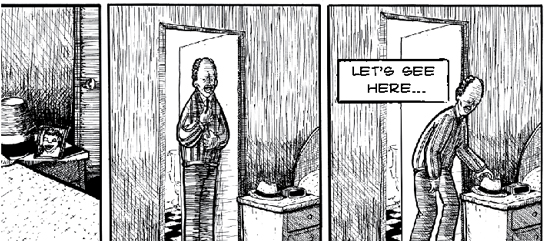
A sample of lettered art from Ragbox, Ch. 4
The fourth chapter of The Ragbox is nearing completion, and (once again) it’s been a fascinating process. I’d like to share some of it here in the hopes that people can learn from my mistakes and my successes.
For those who don’t know, I work with a different illustrator for every chapter. Yes, it’s a logistical nightmare, but it’s my decision and I’m sticking with it, dammit. Chapter 4 is a complete break from the first three chapters, in which we meet a new character in a previously unexplored part of the neighborhood. It’s a quiet, still chapter with a strong character focus. I wanted to work with someone who had a good grasp of creating mood and character. I was thrilled, then, when Joel Christian Gill agreed to work with me.
Joel Christian Gill is a hell of an illustrator, member of the Boston Comics Roundtable, and the Foundations Chair a New Hampshire College of Art. He’s also got two or three other comics projects he’s juggling, so I was glad he could make time for this.
Any effective collaboration requires both parties opening a good line of communication. Joel lives in New Hampshire. I live in Cambridge. At best, we might see each other once or twice a month at Roundtable meetings. Fortunately, Joel’s a resourceful guy. When he wanted to run some layout questions by me, he simply whipped out his iPhone, shot a video, and emailed it to me. I’ve included one of them below.
Lettering
While I don’t draw any of the art in my books, I do the lettering, partially because I can, and partially because I enjoy it. After writing the script, it’s immensely satisfying to have the finished art back in front of you, but still in need of some hands-on work. I feel like the project has come full circle back to me. There’s also the practical reason of creating some uniformity. In a story with 25 artists, you need as many follow-throughs as you can provide, and lettering is a great way to do that (Todd Klein’s work on Sandman taught me that).
Production
Then there was the question of producing the actual books. This is my first mini comic, which presented some unique obstacles. I’ve gone about this backwards compared to most people. My first book, The Ragbox, Volume 1, was printed offset and perfect-bound by a big, professional printing company in Texas. All the Inbound anthologies I co-edited for the Roundtable were also larger-scale productions. I know exactly what it takes to prepare files and hand them off to a printer. But printing 50 to 100 books… that was different.
My inclination was that the small-scale production of mini comics can really benefit from some handmade touches. Take the “Harvest” Star Wars anthology that Shelli Paroline designed (good image of the cover here, sorry for not linking directly to you, Shelli). That’s actually a separate piece of art printed like a photo, then affixed to the cover. Something like that really jumps out at you, and the extra work is entirely feasible if you’re only printing a few dozen at a time. You can always print another batch at a later point.
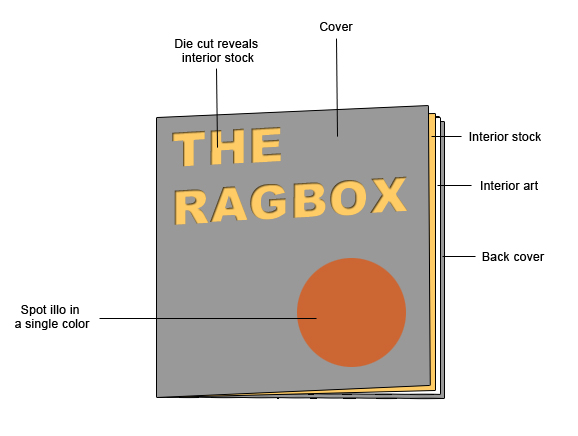
Concept for a cover with die cuts, ultimately abandoned.
So, looking to rip off the good ideas of my friends and came up with the rough concept below. I then proceeded to waste about a week researching die-cutting options for the cover, from outsourcing it to buying my own die-cutting machine. In the end, I learned two things. (1) There are a lot of insane scrapbookers out there, and (2) it just wasn’t feasible for this project, given the deadlines I’d imposed for myself.
So if die cutting was out, I needed another concept for the cover. I thought that Chapter 4 could and should be marketed as a stand-alone book that doesn’t require you to read the previous chapters. So how to create both uniformity and distinction from The Ragbox Vol. 1? First, I wanted Mark Hamilton to do the cover illustration again. I also wanted to pull in at least one of the colors from the Vol. 1 cover, but I didn’t want such a dark cover. It also needed to represent the mood of Mr. Davis, the story’s protagonist. I started thinking about the simple image arrangements and monochromatic or dichromatic blocks in the old album covers of Blue Note. Doing a straight rip-off of an album cover would be overkill, but I could borrow elements. I also had a strong image in my head that I thought might work, and combined it with some influences from ’50s and ’60s Penguin covers of non-fiction books. So I did a quick mock-up in photoshop that would capture the feel I wanted to convey to Mark.
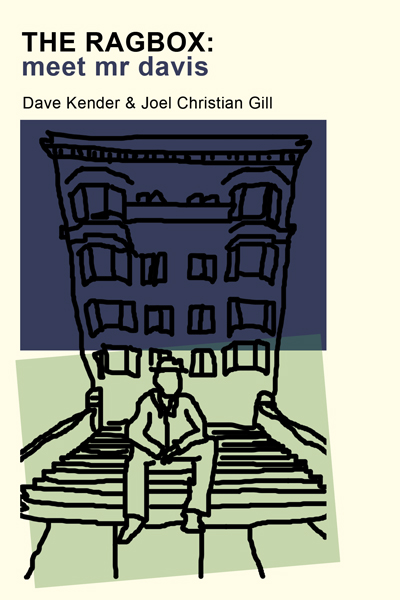
A second mock-up of the cover, just a simple sketch with an approximation of the look and feel
So this is where we’re at, as of right now. The cover is in process. I’m wrapping up the lettering. I’ve narrowed the list of printers down to a few local places. I’m sure that several things could change between now and then, but hey… gotta stay flexible. It’s only comics, after all. Hope you enjoyed this look behind the curtains.
READ ON IN PART 2…