
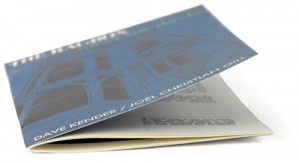
 This is a continuation of an earlier article. To read the first part of this article, click here.
Cover design
In the previous article, you read how the cover started to come together. Unfortunately, the first cover artist fell through, but by that point I had a good idea of what I wanted. So I asked Joel Christian Gill, the artist for the interior art, to do a b/w line art of Mr. Davis sitting on the steps of a house.
I’m not a trained designer by any stretch. Fortunately, I am pretty good at zeroing in on an idea and pursuing it until I get close enough to what I want. There’s always a lot of searching about in the beginning for the right inspiration, but once I hit upon the vintage Blue Note album covers, I had what I needed. The colors that designer Reid Miles used are just incredible. I’ve owned a lot of these albums since high school. In college I had a jazz radio show for three years and spent a lot of time staring at the liner notes in a dimly lit studio.
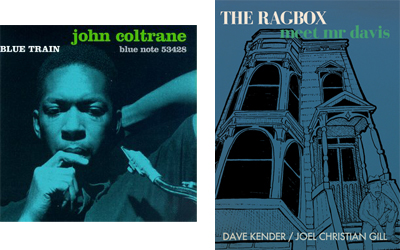
Old Blue Note album covers as a guide
I decided to borrow from the album Blue Train from Coltrane. It’s not an exact match, just a snatching of the blue/black/green color scheme. Unless you put them side-by-side, you’d probably never get the reference. Of course, I had to do some digging to figure out that the font was Bodini.
The back cover is much closer to the source material, the phenomenal Out to Lunch by Eric Dolphy. The Bodini font gets some more play here for the titles, and Futura for the body (at least that’s what I think it is). The original album has such an elegant and efficient layout, to stray too much would have been folly. Unfortunately, the eye is not drawn to the press quotes as much as it could have been, but I was willing to sacrifice marketing for design.
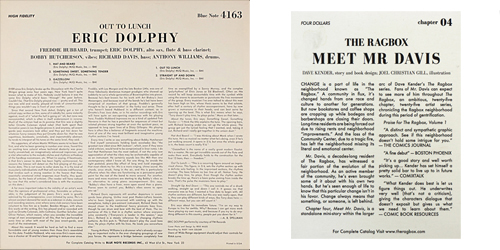
The inspirado versus the final product
Color is Fun, also Hard
My first book was printed offset, but the new book was printed digitally. There are a variety of factors for the decision involving cost, print run, etc., but it created some unexpected challenges for me.
To give the cover and back cover the appropriately “aged” look, I needed to find some aged paper images and throw them into the mix. Just by chance, I found this sample that I liked (see image below), but it added a lot of green. Originally, I’d been intending to match the blue from the first book’s cover, but that was lost along the way. Wow, was I in for a surprise when I got the proofs back and found that the blues did match, despite having completely different color profiles.

In my naivete, I thought that simply using the same CMYK values would suffice. I did not take into account the fact that offset and digital inks are completely different and take to paper in a completely different way. I knew there was some difference, but I never would have guessed it was that drastic. I can’t stress enough how much more you learn by simply jumping in and doing this kind of stuff yourself.
Printing
I’d like to give to an official endorsement (and thank you) to Classic Graphx in Central Square, Cambridge, MA. The staff was great, the service was prompt, they answered all my questions, and the turn-around times were fast. The prices were reasonable but not the cheapest. However, I didn’t want the cheapest. If I’d been looking for a Kinko’s-quality book, I would have gone to Kinko’s. For less money, I also wouldn’t have gotten that staff, service, answers, or turn-around times. The binding, folding, and trimming were also included. You get what you pay for.
The spine pops, which is something I’m not crazy about. That happens with most saddle-stich (stapled) books. If you put a little pressure on the spines, it tends to keep itself closed well enough.
So, that’s it for now. I’m already at work on the Chapter 5, to be illustrated by Line O. Expect to see a screencast video in the future, where I walk through my digital lettering process.